
Montford International College | RTO 46346 | CRICOS 04334A | Version 2.2 – September 2026
PP5 – Credit Transfer Policy
1. Purpose
To ensure VET students receive recognition for previously completed equivalent training products, through a fair, timely, and transparent Credit Transfer (CT) process. The policy also supports international students in accordance with Standard 2 of the National Code 2018.
2. Scope
This policy applies to:
- All VET students (domestic and international) seeking recognition of prior learning via Credit Transfer.
- All qualifications and skill set on MIC’s scope of registration.
- All staff involved in enrolment, training, assessment, student support, and compliance.
3. Definitions
| Term | Definition |
|---|---|
| Credit Transfer (CT) | A formal recognition process that exempts a student from completing a unit of competency that has already been achieved under an equivalent training product. |
| Course Credit | Refers to Credit Transfer (CT) and is used interchangeably. It means granting status or recognition for completed units of competency. |
| AQF Certification Documentation | Official documents such as a testamur or Statement of Attainment issued by a recognised RTO. |
| Authenticated Transcript | A verified training record sourced through the USI Registry or directly from the issuing RTO. |
| Equivalent Unit | A unit of competency considered ‘equivalent’ by training.gov.au (TGA) standards, meaning its learning outcomes and assessment requirements are substantially the same with the previous version of the unit. |
| SMS (Student Management System) | The platform used to manage student enrolments, unit results, and training documentation. |
| Training Plan | A personalised schedule that outlines delivery dates, unit codes, and exemptions (including CT). |
4. Legislative & Regulatory Reference
- Standards for RTOs 2025 – Outcome Standard 1.7
- National Code 2018 – Standard 2
- AQF Qualifications Issuance Policy
- Student Identifiers Act 2014
- Training.gov.au (for equivalency determination)
5. Policy Statement
MIC ensures:
- Students are informed of their right to apply for Credit Transfer (CT) at pre-enrolment, enrolment, and orientation.
- CT is granted where the unit of competency has the same code/title or is listed as equivalent on training.gov.au.
- CT and Course Credit are recognised as the same process under this policy to avoid confusion.
CT is only granted when:
- Valid AQF documentation or authenticated transcripts are submitted.
- There are no licensing restrictions requiring reassessment.
International students granted CT:
- Have their course duration adjusted in the CoE and PRISMS, if applicable.
All CT outcomes are:
- Made within 20 business days of receiving a complete application.
- Notified to the student in writing.
- Stored in the student file and SMS.
- Reflected in training plans and/or class timetables.
6. Procedure – Step-by-Step
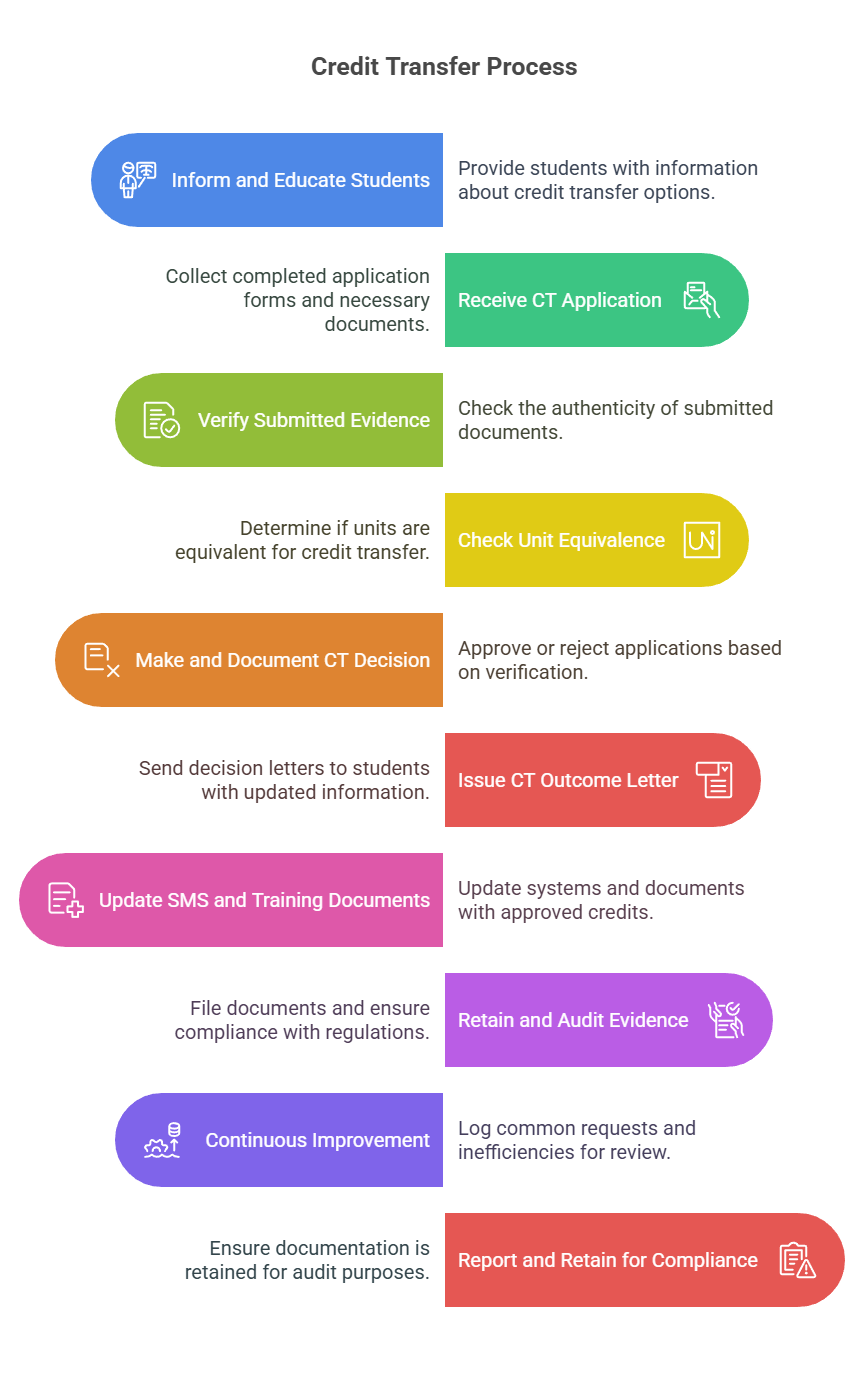
This procedure outlines the step-by-step process for managing Credit Transfer (CT), also known as Course Credit, in compliance with Outcome Standard 1.7 of the Standards for RTOs 2025 and Standard 2.3 of the National Code 2018 for international students.
| Step | Action | Responsible Person |
|---|---|---|
| 1 | Inform and educate students about CT rights. Clearly outline Credit Transfer (Course Credit) options in the pre-training review, Student Handbook, and Orientation presentation. Ensure both domestic and international students understand the CT process and how to apply. | Student Support Officer / RTO Manager/ Compliance Manager |
| 2 | Receive CT application Collect a completed Credit Transfer Application Form and one of the following: Copy of AQF Certification (Statement of Attainment/Testamur) Authenticated USI transcript, | Admin Officer |
| 3 | Verify submitted evidence Cross-check with the USI Registry System or contact issuing RTO (where required) to validate authenticity. | RTO Manager/ Compliance Manager |
| 4 | Check unit equivalence on training.gov.au Refer to the “Mapping” or “Equivalency” field under the superseded/replacement unit. If unit code is same, the unit qualifies for CT. If listed as “Equivalent”, the unit qualifies for CT. If “Not Equivalent”, reject CT or conduct RPL. | Trainer |
| 5 | Make and document the CT decision Approve or reject based on verified documents and equivalency mapping. Record decision rationale in the Credit Transfer Application Form and store. | RTO Manager/ Compliance Manager |
| 6 | Issue a CT outcome letter Send Credit Transfer Decision and Outcome Letter (approved/declined) to student. Include updated unit list and changes to course duration (if any). For international students: create CoE according to course duration changes. Update PRISMS if course credit is granted after the overseas student’s visa is granted. | Admin Officer |
| 7 | Update SMS and training documents Enter CT-approved units in SMS. Update the training plan or timetable. Notify relevant trainer. | Admin Officer |
| 8 | Retain and audit evidence File CT form, decision letter, and verified transcript/certification. Ensure CT record aligns with AQF documentation register. | RTO Manager/ Compliance Manager |
| 9 | Continuous improvement Log common credit requests or inefficiencies in CI Register for review. | RTO Manager/ Compliance Manager |
| 10 | Report and retain for compliance Ensure documentation is retained for 2 years for audit purposes. | RTO Manager/ Compliance Manager |
7. Validation Criteria
Credit Transfer decisions must:
- Be supported by certified AQF documentation or authenticated USI transcripts.
- Be based on unit equivalency status confirmed via training.gov.au.
- Be consistently applied and traceable in SMS and student files.
- Avoid duplicate delivery of previously completed learning.
- Be compliant with licensing or regulatory requirements where applicable.
8. Related Documents
- Credit Transfer Application Form
- CT Decision and Outcome Letter
- Training.gov.au Equivalency Mapping
- USI Transcript or Verification
- Continuous Improvement Register
- Student Handbook
9. Flow chart
PP8 – Recognition of Prior Learning (RPL) Policy
1. Purpose
This policy ensures that all domestic and international students are informed of their right to apply for Recognition of Prior Learning (RPL) and are supported throughout the process. It ensures that all RPL decisions preserve the integrity of the training product, comply with training package requirements, and meet the obligations under the Standards for RTOs 2025 and National Code 2018 – Standards 2.3 to 2.5 (RPL only).
2. Scope
This policy applies to:
- All nationally recognised qualifications and units on MIC’s scope of registration
- All prospective and enrolled domestic and international VET students
- All MIC staff involved in student recruitment, enrolment, training, assessment, and compliance
3. Definitions
| Term | Definition |
|---|---|
| Recognition of Prior Learning (RPL) | The process of assessing a student’s existing knowledge, skills and experience against the requirements of a unit of competency or qualification. |
| Competency | Consistent application of knowledge and skill to the level required in the workplace. |
| RPL Kit | A structured guide and set of tools used by assessors and students for preparing and completing the RPL process. |
| Training Plan | A formal plan outlining unit delivery and any exemptions (including RPL) tailored to each student. |
| Course Credit | A broader term which includes RPL. For clarity, in this RPL policy, RPL and course credit are used distinctly. |
| PRISMS | Provider Registration and International Student Management System – used to report changes to a student’s enrolment. |
| CoE | Confirmation of Enrolment – the official document issued to international students for visa purposes. |
4. Legislative References
- Standards for RTOs 2025 – Outcome Standard 1.6
- National Code of Practice for Providers of Education and Training to Overseas Students 2018 – Standards 2.3, 2.4, 2.5
- National Vocational Education and Training Regulator Act 2011
- AQF Qualifications Issuance Policy
- Training.gov.au – Training Package Guidelines
5. Policy Statement
MIC’s RPL Position (Suitability Assessment)
MIC has assessed its suitability to conduct RPL across the training products on its scope and has determined that it is not suited to offering RPL as a standard enrolment or completion pathway. This position reflects the nature of MIC’s scope and student cohort: MIC’s students are predominantly adult international students on student visas, enrolled in full-time CRICOS-registered qualifications (SIT commercial cookery and hospitality, CHC individual support, disability and community services, and BSB graduate management) whose CoE duration, study load and visa arrangements are established on the basis of full course delivery; the majority of units on MIC’s scope carry assessment conditions requiring demonstration in a real workplace and/or completion of mandatory work placement hours, which portfolio-based RPL evidence alone can rarely satisfy; and MIC’s assessment system and resources are structured around full delivery with supervised work placement rather than RPL portfolio assessment. This position is consistent with ASQA’s guidance on the 2025 Standards — the 2025 Standards Frequently Asked Questions (ASQA, version 3.0, October 2025), which recognise that enabling RPL may not be appropriate or practical in all circumstances, and ASQA’s sector webinar guidance on the 2025 Standards (November 2025), which acknowledged that a provider may identify that it is not suited to delivering RPL.
Consistent with Outcome Standard 1.6, MIC nevertheless:
- informs every prospective student about what RPL is and their right to seek it (pre-training review, Student Handbook and orientation);
- accepts and considers every written RPL application received — no application is refused without assessment of its evidence base;
- where an application demonstrates a strong evidence base, either conducts the RPL assessment with full rigour under this policy, or advises the student — before enrolment and without disadvantage — that they may seek RPL from another RTO with the training product on scope;
- never discourages, penalises or misleads a student in relation to RPL.
Credit Transfer (PP5) remains fully available and is not affected by this position. This suitability position will be formally reassessed at the next scheduled revision of this policy, and at every subsequent policy revision, against the ASQA guidance current at that time, with the outcome recorded in the Version Control table and the Continuous Improvement Register. Every decision made under this position is documented in the student file.
MIC is committed to recognising prior learning in a way that is:
- Transparent, fair, and consistently applied
- Supported by a structured process with clear guidance for students and assessors
- Based on valid, sufficient, current, and authentic evidence (Rules of Evidence)
- Only conducted by qualified assessors using MIC-approved tools
- Compliant with National Code 2018 where applicable to international students
International Students – RPL Specific Clauses (National Code 2018):
- A written RPL outcome letter is issued and accepted by the student.
- The record is retained for 2 years after the student ceases to be enrolled.
- If RPL shortens the course duration:
- The revised CoE is issued for the shorter duration.
- Any change in course length is reported to PRISMS.
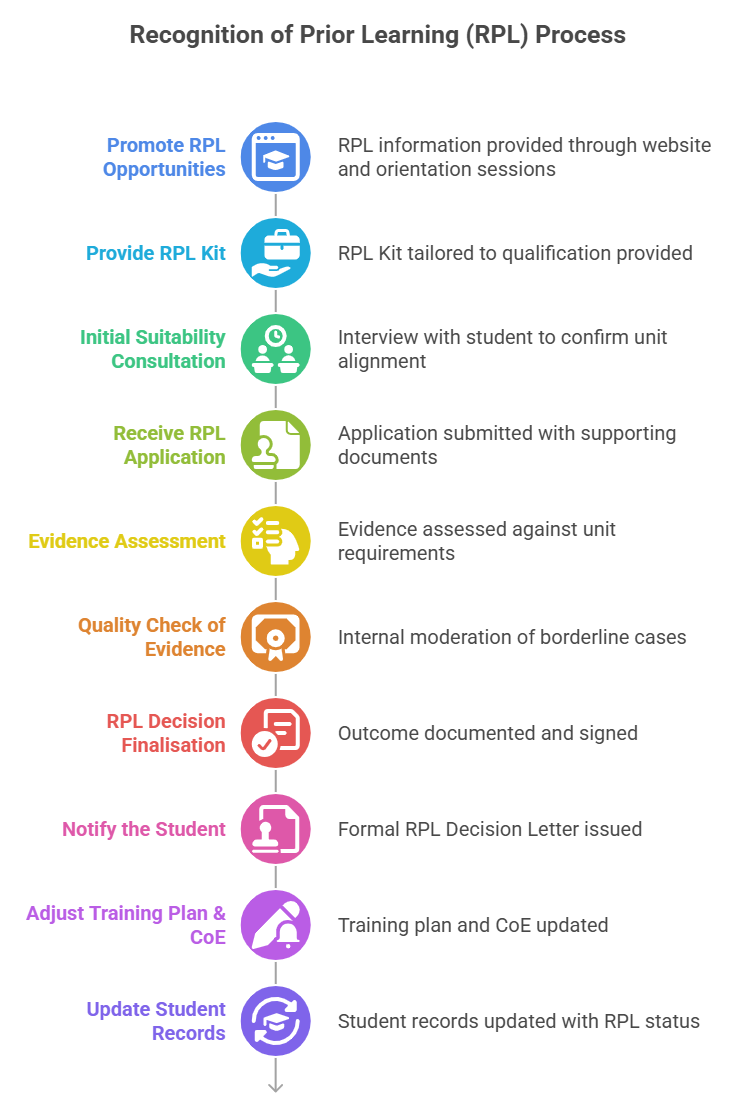
6. Procedure – Step-by-Step
| Step | Action | Responsible Person |
|---|---|---|
| 1 | Provide RPL Information RPL information is provided through: Website and pre-training review and orientation sessions | Admin Officer |
| 2 | Provide RPL Kit RPL Kit tailored to the qualification is provided to the student including: Unit mapping Evidence requirements Application form | RTO Manager/ Compliance Manager |
| 3 | Initial Suitability Consultation Conduct interview with the student Confirm unit alignment and evidence type/volume Confirm student understanding of RPL process | Trainer |
| 4 | Receive RPL Application Application submitted with resume, work samples, employment references, previous qualifications, and other supporting documents. | Student |
| 5 | Evidence Assessment Assess evidence against unit requirements Use assessment instruments to support decisions Conduct verbal questioning, observations or challenge tasks if needed Ensure evidence meets: Validity, Authenticity, Currency, Sufficiency | Trainer |
| 6 | Quality Check of Evidence Conduct internal moderation of borderline or high-risk cases Confirm assessor qualifications and consistency of judgement | RTO Manager/ Compliance Manager |
| 7 | RPL Decision Finalisation Document the outcome (Competent / Not Yet Competent) Sign RPL Assessment Record File all supporting documents in student record | Assessor / RTO Manager/ Compliance Manager |
| 8 | Notify the Student Issue formal RPL Decision Letter Include unit codes and decisions For international students: retain signed copy for 2 years post-enrolment | Admin Officer |
| 9 | Adjust Training Plan & CoE (if applicable) Update Training Plan If course duration shortens: revise CoE and update PRISMS Ensure updated training plan reflects RPL decisions | Admin Officer |
| 10 | Update Student Records Update SMS with RPL unit status Tag files for audit traceability Link to the student’s USI where applicable | Admin Officer |
| 11 | Log into CI Register (if needed) Any process issues or improvement opportunities are logged for future review | RTO Manager/ Compliance Manager |
7. National Code 2018 – RPL Compliance Summary
| Clause | Requirement | MIC Compliance Mechanism |
|---|---|---|
| 2.3 | MIC has and implements a documented policy for RPL | This RPL Policy and Procedure form part of MIC’s compliance documentation |
| 2.4 | Written RPL decision accepted by student; record kept for 2 years | Signed RPL Outcome Letter Retained in student file and file checklist |
| 2.5.1 | CoE updated for reduced course duration if RPL granted | Admin Officer updates PRISMS Issues revised CoE |
| 2.5.2 | Course duration change update in PRISMS | Admin ensures prompt PRISMS reporting Compliance monitored by CEO |
8. Validation Criteria
All RPL outcomes must:
- Be based on valid, sufficient, current, and authentic evidence
- Be assessed by qualified assessors using mapped tools
- Be traceable in the training plan, student file, and SMS
- Be consistent with training package rules
- Preserve the integrity of the qualification
9. Related Documents
- RPL Kit
- RPL Assessment Tool
- RPL Outcome Letter Template
- Student Handbook
- Enrolment Form
- Training Plan
- PRISMS Reporting Log
- Continuous Improvement Register
- Student File Checklist
10. Flow Chart
The complete MIC Policy and Procedure Manual is available on request from [email protected].
Questions about this policy? Email [email protected] or call +61 3 7048 4870.
All policies
- Complaints and Appeals Policy
- Fee Management and Refund Policy
- Privacy Policy
- Student Support and Wellbeing Policy
- Credit Transfer and Recognition of Prior Learning (RPL) Policy
- Diversity, Inclusion and Disability Policy
- Student Transfer Policy
- Deferral, Suspension or Cancellation of Enrolment Policy